Tuesday, May 14, 2019

Inishboffen

It was scheduled to be a "rest" day off the bike, but the weather was bright and sunny and we didn't want to waste it. So we combined a ride with a visit to another of the many islands off the western coast of Ireland.

We started off with a ride on the high road out of Clifton. With the clear day we could see to the horizon both north and south.


Then it was a pleasant meander to the ferry (with occasional livestock sightings).


Inishboffen is Irish for Island of the White Cow. Legend has it that early settlers saw a woman strike a white cow with a stick, turning it to stone. They (the woman and the cow) then appeared periodically as an omen of an important event, generally a disaster of some sort.


There are perhaps 8 or 9 km of roads on the island so we did a short tour seeing:


  • The remains of a fort built by Cromwell, who was eliminating the catholic clergy in Ireland after his victory in the War of Roses in England -- and needed a place to house them until they were either hung or shipped to the West Indies


  • and the site of the ruins of a 7th century monastery.

and then a stop for a leisurely cup of coffee before heading back to the mainland.


The surprise of the day was a sandy beach that wouldn't look out of place in the Caribbean or Mexico.


More trip pictures are archived at:  https://photos.app.goo.gl/i3Wq9Epv9sqDXb5w6 

Sunday, May 12, 2019

North to Connemara

Is it Connemara or Conamara?   The local signs say Conamara


while most of the online websites (including the ever wise Wikipedia) use Connemara. Our guide tells us it was the challenge of translating Gaelic to English (using a phonetic approach) that led to multiple spellings for many areas and landmarks.

The Burren was a barren sheet of limestone with occasional collections of soil and plants,  but this area, north of Galway Bay, is boggy wet grasslands, small tarns, lakes.


The map shows the multiple tarns and lakes.

This is what it looks like from the bike.

Only inches below the surface, readily accessible to a shovel, is a thick layer of peat. Peat is partially decayed vegetable matter which has accumulated over thousands of years. It decomposes slowly in the acidic, oxygen free environment of the bog and. It is the precursor of coal and after being dried can be burned as fuel. It was the original local export to other areas of Ireland.


A peat "ditch" with harvested peat drying by the side.


During our ride we stopped at the site of Marconi's original radio station. It was built on a peat bog - which provided an unobstructed view of the horizon to the west as well as plenty of peat to provide the power needed to generate a signal.


Within a mile of the station, is the landing site of the first nonstop transatlantic flight. Alck and Brown, two British flyers, 1919, Newfoundland to Ireland.


As to our riding, the weather remains cold (low 50s with that bitingly cold north wind). It is dressing for the cold, not rain, that has been the gear challenge of the trip. But things are looking sunnier and a bit warmer for the net few days of riding.

Our route from The Burren to Connamera


More trip pictures are archived at:  https://photos.app.goo.gl/i3Wq9Epv9sqDXb5w6 

Friday, May 10, 2019

Ireland days 3 and 4 - The Aran Islands.

Next stop, the Aran Islands.


An hour crossing by ferry from The Burren. Not a Washington State type ferry, but more a converted trawler or purse seiner.  The Happy Hooker, a double entendre for sure, is named for a type of traditional fishing boat used in Galway Bay.


The weather was unsettled the day we arrived, but as you will see from pictures, day 2 was much better. It has been funny weather in Ireland this spring. It isn't the rain or drizzle that is the challenge, it is the wind which has been coming out of the north (the Beast of the North) rather than the prevailing westerlies. And it is bone chillingly cold. Lower 50s for a daily high instead of the usual 60's that we were hoping for.

The island is about 20 km long, and the highlights are the ruins - multiple churches and a couple of forts, one of which was built in 11 BC.


The monks of the early orders of the Catholic church felt that the more desolate a location, the better to meditate and know the Lord. So these islands, very isolated, were a coveted destination. And it seems every one of them built a church, now a ruin.

And then there are the walls. Walls, walls, everywhere.


The island is 20 km long but is estimated to have over 3000 miles if walls.  Walls serve 3 purposes.

      A place to put the stones cleared from the land.
      To mark property boundaries. And until recently you were required to wall any new land purchase not walled already. So these walls define individual ownership.
      To provide protection from the relentless wind.

The walls are purposely built like a sieve to avoid being blown over by the wind. It is more common that a wall would be damaged by livestock.


Tomorrow back to the mainland and north to Connemara.

More trip pictures are archived at:  https://photos.app.goo.gl/i3Wq9Epv9sqDXb5w6 


Ireland Day 2 of biking - The Burren

I'll remember 2 things about Lisdoonvarna.

First, the matchmaking festival. For 5 weeks every fall singles, and now couples, come to Lisdoonvarna to party and meet others. What started off as a way for farmers, after the crops were in, to bring their sons and daughters to a meet a mate, has morphed into a party for everyone. And the town plays it up.


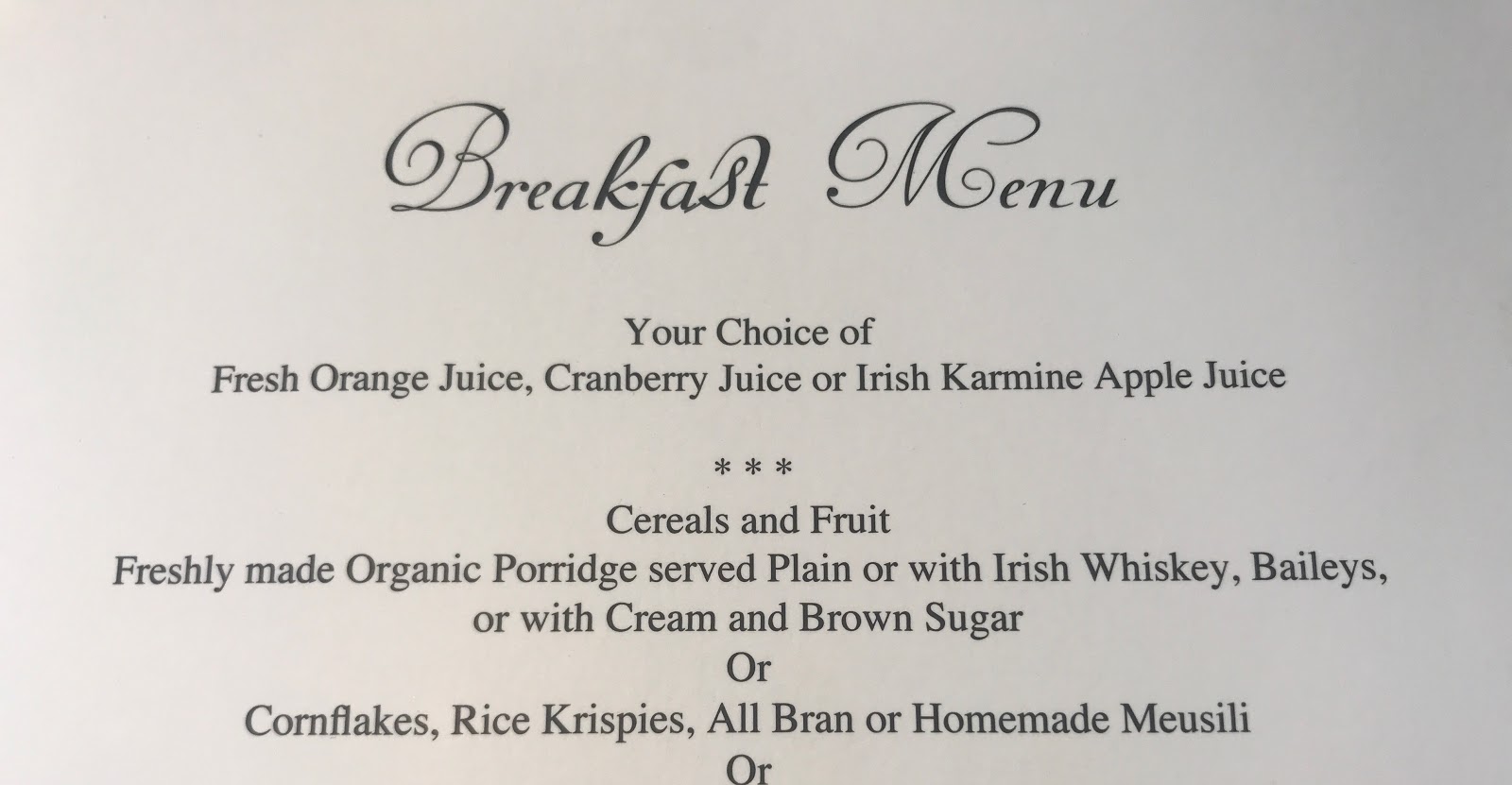
Second was a breakfast that included porridge (oatmeal) served with Irish Whiskey or Bailey's.


Fortified, we set off to ride The Burren. It is treeless, almost plantless, limestone (remember the Cliffs of Moher?) scoured by glaciers with a few glacial erratics strewn about. It is said about TheBarren:

     Not enough water to drown a man (lakes, rivers)
     Not enough wood to hang one
     Not enough earth to bury him.


Other highlights included our first chance to try out our rain gear (just a drizzle, but at 50 degrees it would have been better if it was sunny) and a visit to Stone Age tomb from 2500 BC. They found bones of 33 different bodies buried over a span of 800 or 900 years. It is the best preserved in Ireland.


Where we have cycled the last 2 days.


Tomorrow we visit the Aran Islands.

Trip pictures are archived at:  https://photos.app.goo.gl/i3Wq9Epv9sqDXb5w6 

Wednesday, May 8, 2019

Ireland Day 1 of biking - the Cliffs of Moher.

It was going to be a small group. A few people dropped out when it was time for the final payment, so we are 4 intrepid travelers and Wilma, our guide.


After a nights rest and "charging our batteries" (e-bikes for all of us) , we "saddled up",  and set out.


Day 1

The seaside town of Lahinch and the Cliffs of Moher.

Lahinch is home to a world famous gold course - on the dunes next to the Atlantic. I was struck by how short the holes were, and how uneven the entire course. Nothing flat including the fairways. I suspect it is played entirely with irons, the challenge being to keep the ball from rolling the wrong way on every shot.


It is also one of the more popular surfing beaches in Ireland. Look hard and you may see a few hardy souls in wetsuits. It was a cold and cloudy day - maybe 52 or 53 degrees F.


The west coast of Ireland is old seabed, a limestone slab, that is lifted on the west. The Cliffs of Moher are the edge of that limestone slab. Dramatic, but those we saw in Wales in Pembrookshire are longer and more dramatic.


Tomorrow - The Burren.


Trip pictures are archived at:  https://photos.app.goo.gl/i3Wq9Epv9sqDXb5w6 

Tuesday, May 7, 2019

Boston to Ennis - short flight, big jet lag.

Flying to Ennis takes less time than Boston to Seattle.  Which sounds like it should be a breeze....except the only direct flights leave Boston at 7:30 PM and arrive 6:30 AM local time (which is 1:30 AM Boston time).

So not only is departure too early, and the flight too short, to catch a nap on the plane, you arrive in Ireland just as the sun is coming up and then have to stay awake. A set up for a long first day, topped off with a painful fight to stay awake until at least 7 or 8PM. Tougher jet lag than our last trip to New Zealand.

We shuttled to the Hotel in Ennis and amazingly (compared to the US) were able to check into our room at 7:30 AM.


Ennis comes from the Irish word for "island". Like Montreal, Canada, Ennis was built on an island - in the River Fergus. Over time one branch filled in and now there is just the single river flowing through town.


We took a city tour the day of arrival. The major historical attraction is the Franciscan Friary built in the mid 1200's. 


St. Patrick brought Catholicism to Ireland in around 600 AD. The island was Catholic until the 1500s when Henry VIII founded the Anglican Church and began actively persecuting catholics. Unrelated, but around the same time, the Irish Kings pledged fealty to him, Ireland became a part of England, and catholics second class citizens.

Unrest surfaced in the 1800s with the election of the first catholic to public office.  Then 100 years later, in 1916, rebellion led to the founding of Ireland as an independent country. The central area of the old town has a monument to a local favorite son, Daniel O'Connell that first Catholic office holder.


We learned that the town has numerous boxing clubs - which fits with the Irish reputation as always enjoying a good brawl.  We were told they revere Mohammed Ali who is said to have Irish ancestry. He was feted as hero when he visited in the late 1990s.


, 

After getting a good night's got a sleep (12 hours for me), we took a walk outside of town to see the local country side.


Tomorrow,  e-bikes!!

-------


Trip pictures are archived at:  https://photos.app.goo.gl/i3Wq9Epv9sqDXb5w6